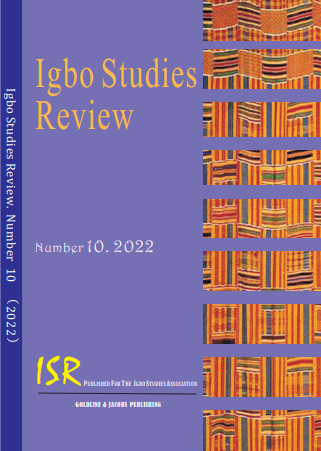
Igbo Studies Review, Number 10 (2022), Is Now Published and Available Online
We are pleased to announce the publication of Igbo Studies Review (ISR), Number 10 (2022), now available through our website. This new issue continues the journal’s commitment to advancing rigorous, interdisciplinary scholarship on Igbo history, society, culture, religion, politics, and the wider Igbo diaspora. As described in the journal’s editorial policy, Igbo Studies Review is an annual, peer-reviewed publication of the Igbo Studies Association that welcomes original research across the disciplines on all aspects of Igbo studies.
Edited by Chima J. Korieh, with associate editors Akachi Ezeigbo and Apollos Nwauwa, this issue reflects the journal’s strong scholarly network and its continued role as an important platform for critical conversations in the field.
Number 10 (2022) brings together five full-length research articles and three book reviews, offering readers a rich and varied exploration of themes central to Igbo studies today. The issue’s table of contents shows a strong balance between history, politics, gender, architecture, religion, and intellectual review.
The issue opens with Kingsley C. Ezeuwa’s article, “Ireland and Biafra Compared: Historical Hatred for Empires and Veneration of Nation-states in the 1900s.” This essay places Biafra and Ireland in comparative perspective, arguing that both peoples shared experiences of cultural consciousness, political aspiration, and resistance to domination, even though their struggles produced different international outcomes. The article invites readers to reflect on nationalism, empire, and the global order in the twentieth century.
A second major contribution, by Samson Uzodinma, Keneth Asogwa, and Chima J. Korieh, examines the economic consequences of IPOB’s sit-at-home protests in northern Igboland. Their study argues that the protests have moved beyond political symbolism to become a serious burden on local livelihoods, especially for traders, transport workers, and rural communities dependent on informal economic activity. This article offers an important intervention into current debates about protest, insecurity, and economic survival in southeastern Nigeria.
In “Gender and Labor Roles in Building Construction in Abakaliki, Nigeria,” Rosemary Akpan explores a striking social reality: women’s visible and significant participation in construction labor in Abakaliki. Her article challenges long-standing assumptions about gendered divisions of labor and shows how women’s work in building sites reshapes our understanding of labor history, urbanization, and social change in southeastern Nigeria.
The issue also includes Moses Oñugadi Njoku’s thoughtful study of indigenous architecture, “African Architectural Identity in the Time of Globalization: The Example of Obi Building Style of Southeast Nigeria.” Drawing on photographs and interviews from different parts of Igboland, the article shows how the traditional obi has evolved while still retaining cultural and ecological meaning. It is a timely reflection on heritage, identity, and the pressures of globalization.
Rounding out the articles section is Ononiwu A. Oparah and Anthony C. Ebunsi’s “The Sanctity of the Kola Nut Ritual as a Symbol of Communion of Saints in Igbo Tradition.” This essay explores the spiritual significance of the kola nut in Igbo cosmology and places it in dialogue with the Christian doctrine of the Communion of Saints. In doing so, it highlights the depth of Igbo religious symbolism and the enduring importance of preserving indigenous knowledge and practice.
The reviews section further enriches the issue with engagements with recent books on war, environmental justice, and African development. Among them is a review of Roy Doron’s Biafra: A Military History, presented as a wide-ranging account of the Nigeria-Biafra War and its human, military, and political dimensions. The issue also reviews Domale Dube’s Ogoni Women’s Activism, highlighting its contribution to scholarship on gendered resistance and environmental justice, as well as Leadership and Economic Development Challenges in Post-Colonial Africa.
Taken together, this issue of Igbo Studies Review demonstrates the vitality and breadth of contemporary Igbo studies. From comparative historical inquiry to present-day political economy, from women’s labor to architectural identity and sacred ritual, Number 10 (2022) offers readers a compelling snapshot of the questions shaping the field today. It is both a scholarly achievement and an invitation to deeper engagement with Igbo history, thought, and lived experience.
We invite scholars, students, and general readers to explore this new issue through our website and join us in celebrating the continued growth of research and reflection in Igbo studies.
https://igbostudies.org/journal/igbo-studies-review/igbo-studies-review-10-2022/
Chidi Igwe, PhD
Regina, Canada
Add a Comment
Comments are reviewed before publication to protect the site from spam.