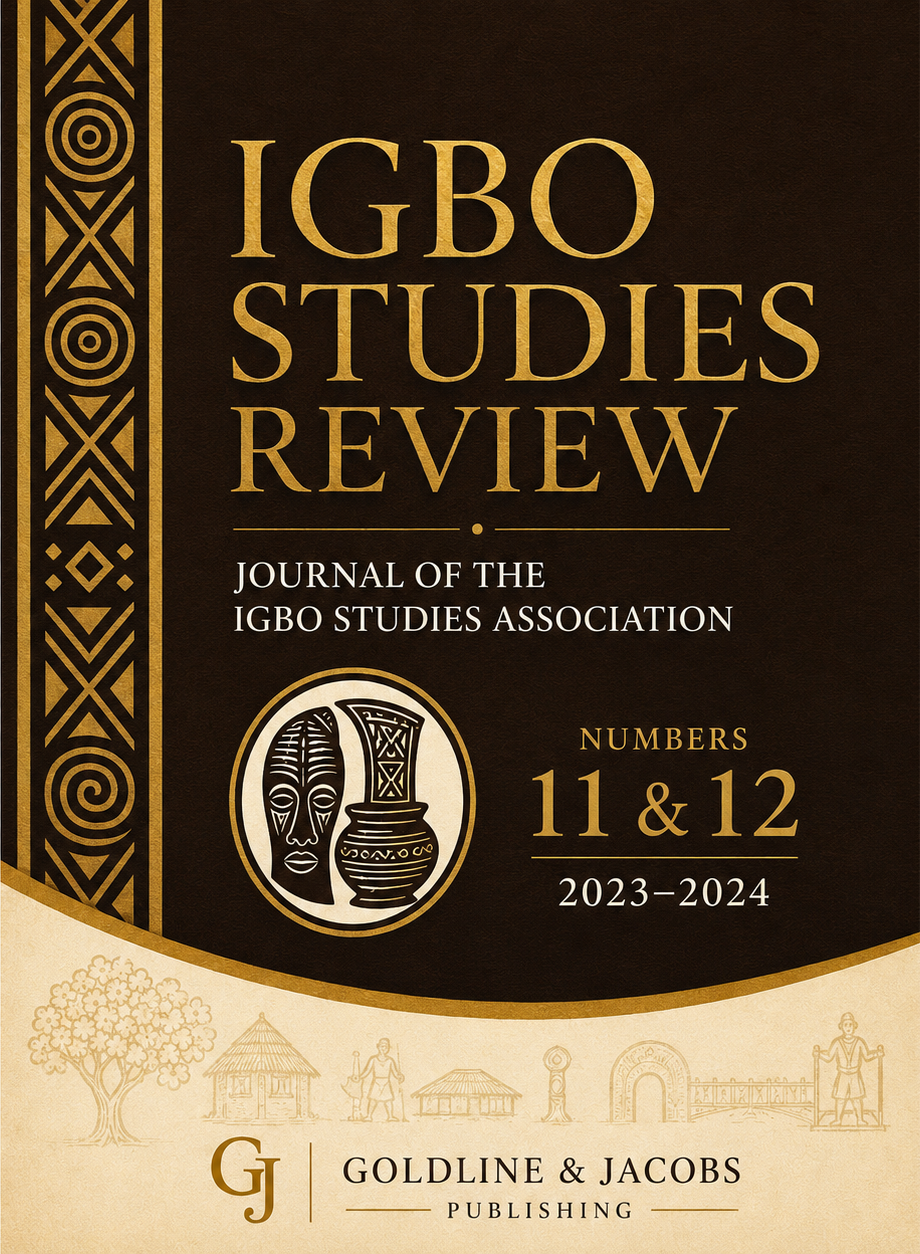
Igbo Studies Review, Numbers 11 & 12 (2023–2024): A Decade of Publishing Igbo Scholarship
Igbo Studies Review (ISR) Numbers 11 & 12 (2023–2024) marks the journal’s tenth anniversary as the flagship publication of the Igbo Studies Association (ISA). Edited by Chima J. Korieh, this double issue reaffirms the journal’s mission to advance interdisciplinary scholarship on Igbo history, culture, literature, language, society, and development while challenging colonial narratives and centering Igbo intellectual traditions.
In his Editor’s Note, “Igbo Studies Review: A Decade of Publishing Igbo Scholarship,” Korieh traces the ISA’s founding in 1999 at the African Studies Association meeting and the journal’s launch in 2013. He reflects on the Association’s goals of promoting Igbo research, forging intellectual networks, and preserving the Igbo language. Korieh highlights the journal’s role as a living archive of the “Igbo Intellectual Tradition” and calls for renewed attention to Igbo origins, pre-colonial democratic institutions, gender dynamics, the Nigeria-Biafra War, and contemporary issues of identity, marginalization, and cultural survival in post-colonial Nigeria.
The six original articles showcase the journal’s breadth:
- Ada Uzoamaka Azodo rereads Chinua Achebe’s Arrow of God as Igbo speculative fiction. She explores Igbo cosmology, the supernatural, power dynamics in Umuaro, Ezeulu’s hubris, traditional rituals, and “what if” scenarios, arguing that the novel offers usable materials for rebuilding a robust Igbo future rooted in indigenous knowledge.
- Chidi Igwe engages Ada Uzoamaka Azodo’s book Literary Criticism Reevaluated: Challenging a Rigid Creative-Critical Dichotomy. He demonstrates that literary criticism is itself a creative genre and examines marriage, patriarchy, and female agency in Igbo women’s writing, with focused readings of Flora Nwapa’s Efuru and Comfort Nwabara’s Ola: The Passage of an Igbo Girl.
- Mathias Ikechukwu Asadu investigates the Japan International Cooperation Agency (JICA) and the development of the rice industry in southeastern Nigeria (1976–1993). Drawing on archival sources and oral interviews, he analyzes the Lower Anambra Irrigation Project’s origins, implementation, and transformative impact on food security and commercial rice production among post-civil war communities.
- Euzebius Chinedu Ugwu applies new institutionalism to examine institutional divergence and policy evolution in post-Brexit United Kingdom and Northern Ireland.
- Victor Ukaogo and Ogechi Ukaogo offer a critical appraisal of women’s rebellion and social-political authority in the gender relations of Ozuitem, Southeast Nigeria.
- Elike Ikechukwu and Nathan Oguchie critique mandatory impact-factor journal publication in Nigerian universities as a symbol of post-colonial self-enslavement.
The issue concludes with Rosemary Akpan’s review of Ada Uzoamaka Azodo’s Literary Criticism Reevaluated.
Collectively, this double issue demonstrates the vitality of Igbo Studies as a field that bridges literary innovation, historical inquiry, gender analysis, agricultural development, and policy critique. It reaffirms ISR’s commitment to rigorous, culturally grounded scholarship that advances understanding of the Igbo experience in Africa and its diaspora.

Add a Comment
Comments are reviewed before publication to protect the site from spam.